
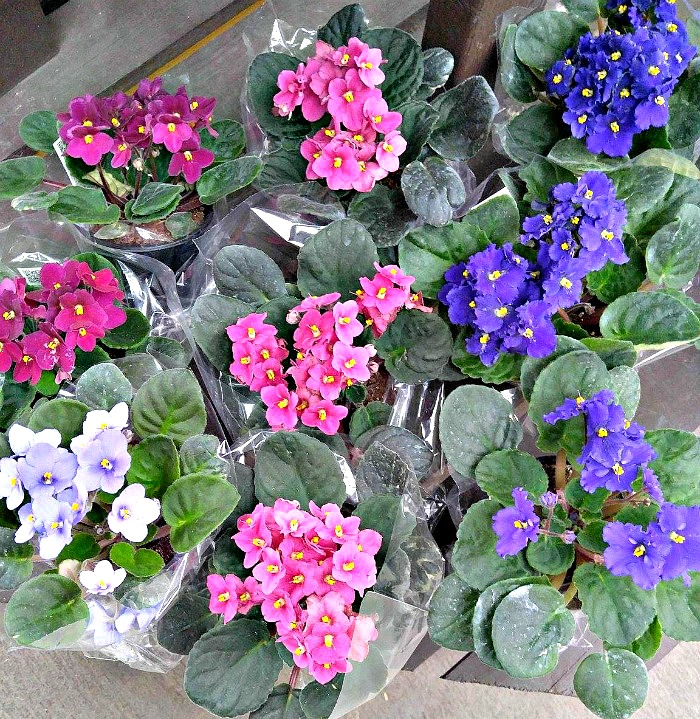
If you go to the big box hardware stores around the holidays and during the winter months, you will most likely find African Violets for sale in a lovely variety of flower colors.
Even though African Violets can be somewhat picky about care, they are still one of the most popular indoor plants grown. 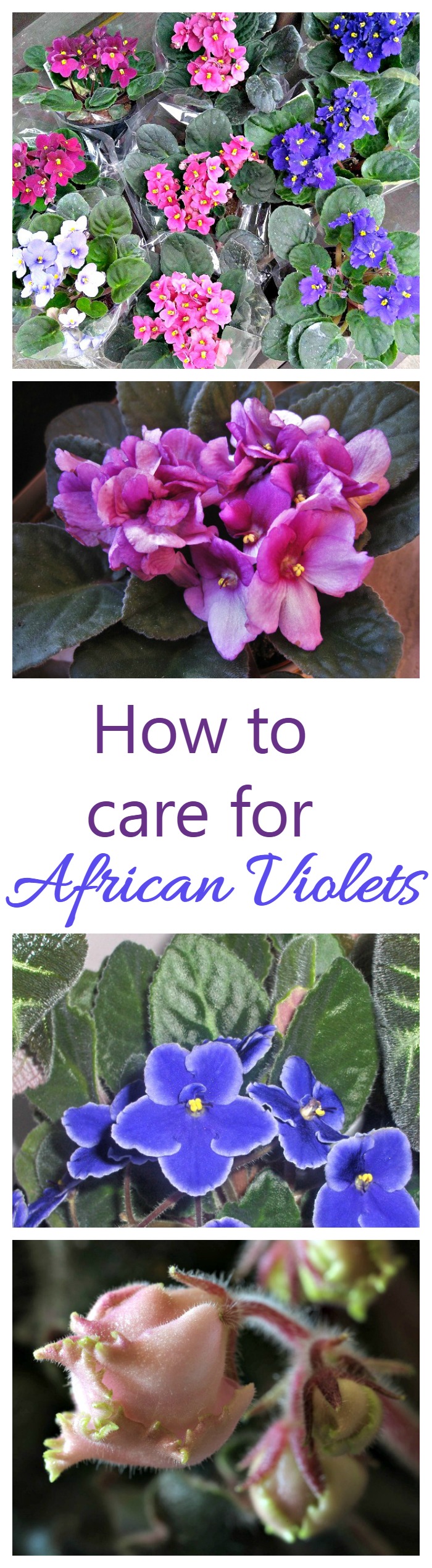
If you love to grow flowering indoor plants, Saintpaulia, commonly known as African violets, are one of the few houseplants that will continuously flower throughout the year.
This is probably one of the reasons for their popularity. If you like to see flowers coming out in the spring, you will enjoy having an African violet or two as a house plant.
African Violets are pretty and they are also pretty picky about certain things. These tips will help to make sure that your African violet keeps flowering and does not end up with shriveled or waterlogged leaves.
African Violets Growing Tips.
Saintpaulia is the botanical name for African violets. The name came when Baron Walter von Saint Paul-Illaire discovered the plant in Tanzania and brought seeds from it back to his father in Germany in 1892. The plant is part of a genus of 6–20 species that has been hybridized into thousands of varieties. Here are some tips on how to care for these lovely plants.
Soil needs
African violets like a light, well draining soil. You can buy retail African Violet potting soil, or can make your own with equal parts of vermiculite, peat moss and perlite.
Sunlight needs for African violets
African violets do best in east or west facing windows. They typically like moderate, bright indoor light. Normally, they do not like direct sunlight, but you could move them to a south facing window for the winter months.
To bloom best, they will require bright, indirect light for most of the day. Also, don’t forget to rotate the plant so that it gets even light. This will help it to grow well in all directions evenly.
If you have lower light in your home, African Violets can still be grown with the help of an indoor grow light.
Humidity requirements
These pretty plants will complain if the air is too dry. Humidity is very important for keeping their leaves in the best condition. If your air is dry, consider growing them sitting on a tray of pebbles with water in the tray.
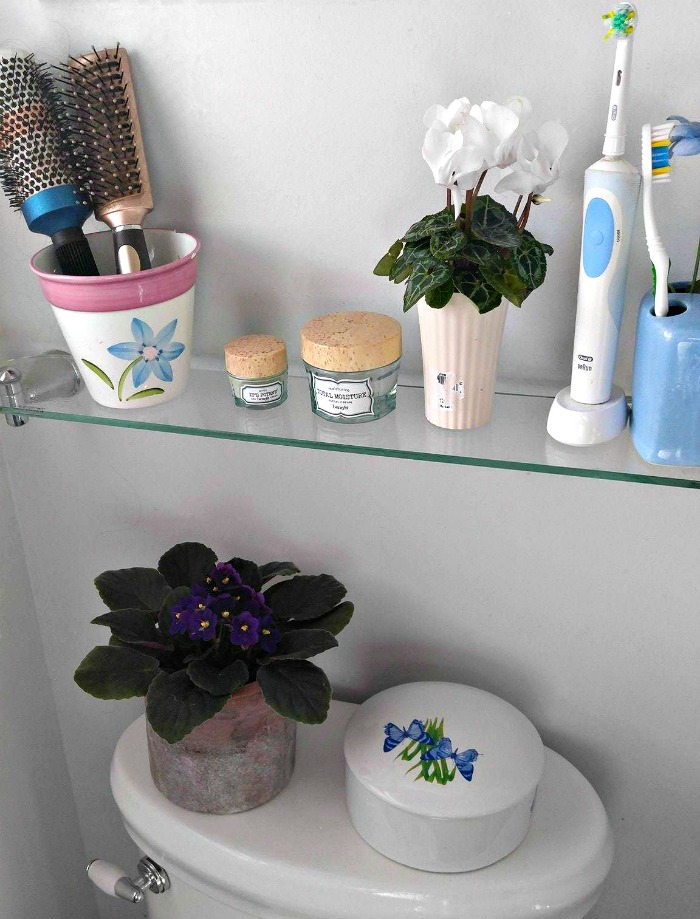
Good air circulation is a must for maintaining the right humidity level. If you have a sunny spot in a bathroom, their humidity levels will be easier to maintain.

Temperature needs
African violets like temperatures that range from 65 º to 75 º. Below 60 º and they won’t grow and flower well. Below 50 º and they will likely die.
They can take temperatures higher than 75 º if their other requirements for water, humidity and fertilizing are met.
Fertilizing African violets
Most flowering plants need fertilizing to continue flowering when they are grown in containers and African violets are no exception. There is a debate among growers on which works best.
Some say that they like a food with roughly equal amounts of nitrogen, phosphorus and potassium. A standard mix is 14-12-14 for standard sized pots.
Others seem to swear by a special African violet fertilizer with a higher Phosphorus number such as 8-14-9 that are said to promote extra blooms.
Whichever you choose, follow the directions on the container. Fertilizing either too rarely OR too often can result in a lack of blossoms.
 Moisture needs
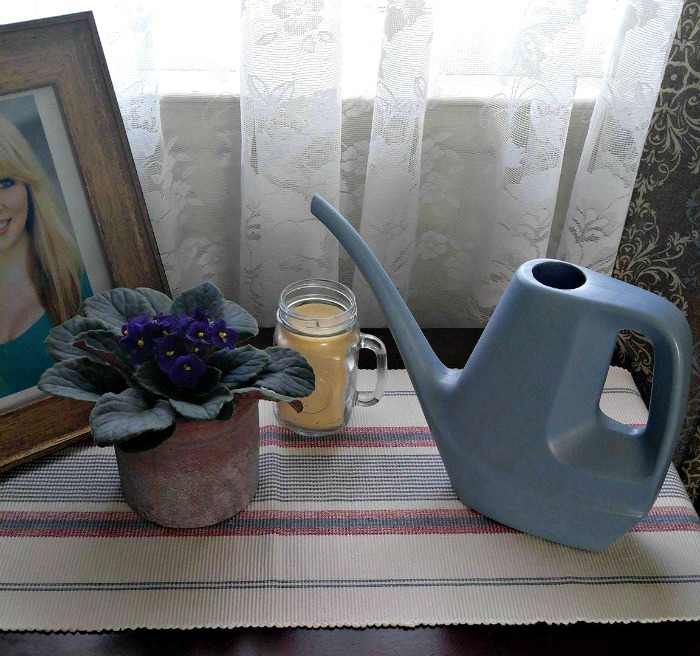
like many indoor plants, African violets want even moisture. I like to test the soil with a finger tip. When it is dry about an inch down, I will water.
Both over and under watering can cause all sorts of problems with the plant. Try to use lukewarm water for best results.
Leaf color and texture
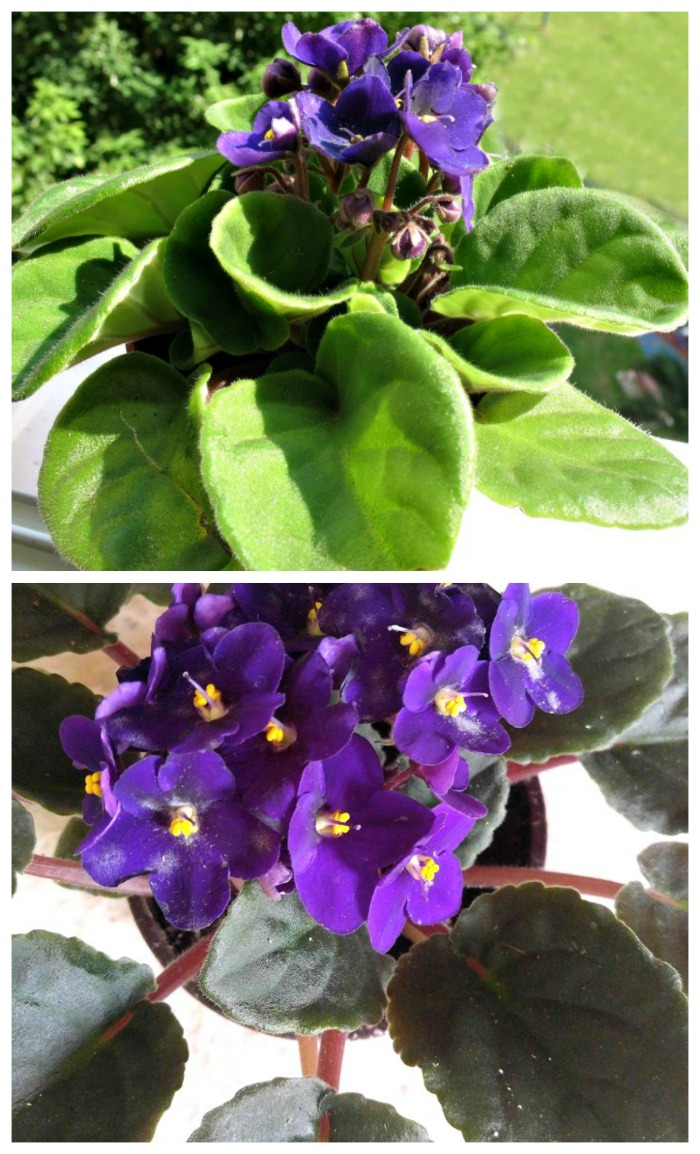
African violets have a variety of shades of leaf color. The leaves have a velvety feel to them and are slightly hairy. The under side of the leaf is often a different color.
African violets with darker green leaves require more sunlight than those with lighter green leaves. (For another house plant with velvety leaves, be sure to check out purple passion plant.) My African violet has dark purple flowers with dark green leaves. The under side of the leaf is a deep purple. Be careful to keep water droplets away from the leaves of the plants When you are watering, or you will end up with splotches on them, just as many hairy leaf plants will do.
Propagating African violets
You can get new plants for free by taking leaf cuttings of your African violets. This is the normal method of propagating them, but African violet seeds are also fairly easy to grow although they are often different from the parent plant if grown this way.
African violets can also be propagated by dividing the crown of the original plant. This works well if it has started to outgrow its original pot.
Colors to enjoy
Many people think of the traditional purple African violet since this is closest to the color of a violet, but they come in many shades from red, white, pink, blue through to purple.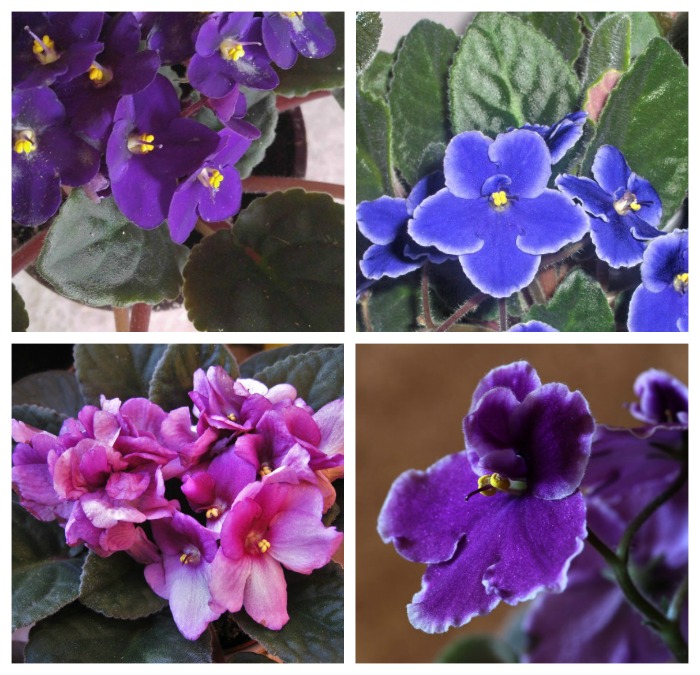
African violet flowers
African Violet flower color is not the only thing that varies. The type of petal can vary too, from single (rimmed with white, or plain) to all sorts of ruffled and double varieties.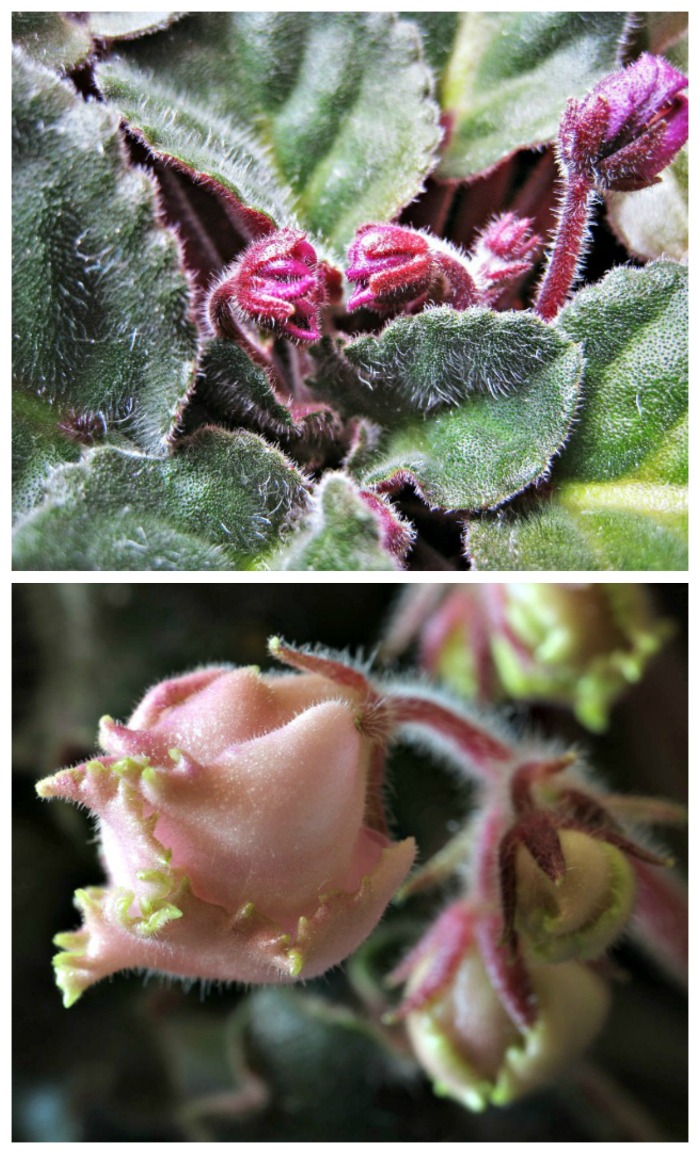 Even the flower buds are lovely before they open!
Pests & problems for African violets
African violets can be picky. These are some common problems
- lack of blooms – check your fertilizer and sunlight. Temps too low can also mean no blooms.
- splotched leaves – keep water away from the leaves
- powdery mildew on both blossoms and leaves – remove diseased parts, and check your air circulation and humidity
- crown and root rot – be careful about over watering
- mealy bugs – inspect any new plants, use a cotton swab in alcohol for light infestations.
Even though African violets are a bit picky about conditions and are susceptible to some common problems, the flowers that they produce all year long are good reasons to persevere in growing them.
Have you had luck growing African violets? What problems did you find when you tried to grow them?
32 responses to “African Violets – Tips for the Care of this Popular Indoor Plant”
I have an afician violet plant that has another attached to the bigger plant.I don’t if know if could cut that one-off without damaging the main plant.
Hi Barb. Yes, you can propagate it. You can either gently pull them apart, or use a sharp knife to cut them apart. Be sure to leave lots of roots on the main plant and make sure that the offset has roots too. African violets will also root from leaf cuttings. Carol
I have tall stalks and probably need to replant. How do I do this?
Hi Michelle. The tall stalks sound more like the plant not getting enough light. If it were me, I’d take the plant out of the pot to see if it is pot bound. If not, I would trim off some of the taller stalks and try to root them as cuttings and move the plant closer to a light source.
If the plant IS root bound you can plant it in a pot about 1/3 size larger at the same crown level.
Carol
How can I get my violets to re-bloom again? I have about 5 or 6 of them at my office desk. They are all healthy but no flowers are coming back. Please help me out. Thanks!
Hi Maria. The normal cause of African violets not reblooming is lack of enough light. They prefer bright, indirect light. (lots of light in winter and filtered light in summer) Too little light will make the leaves stretch to whatever light there is. If you have them in an office, perhaps they are not getting enough?
Another cause of no flowers is lack of humidity. Sitting them on trays of pebbles helps this. If you fertilize, use a low nitrogen, high phosphorous plant food.
Carol
Hi! i recently bought an african violet from walmart, first time i get a plant so dont know much about the proper care, thats why im here. my question is, it came on a plastic pot but i see no drainage holes. its like a black pot inside of a lilac pot, should i just try to make holes or repot? and why is it like double pot? (black one and lilac one)
Sometimes they will put drainage holes in the inside pot but not on the outside one. This is to save the furniture from drip. If the inside pot has no holds, you could poke one in, or replant in another pot that has them. Plants do need drainage. Carol
Hi I just saved a African violet plant from the store. But I have it on my window it don’t get bright light so put there . But do I report it soon or keep it in the pot it came from . It’s a small plant . Help I don’t know what kind of dirt to get or things to help it bloom .from Suzan in sanjose ca.
You can grow it in the pot it came in for a while. If it is a TINY pot, (2″) I would repot it into a larger 4″ pot. I’ve seen some in Lowe’s that are in really tiny pots and they dry out very quickly. Normal potting soil is fine. It might not flower for a while after repotting, since the roots will be growing for a while, but in time, it’ll be a better plant. Carol
I have 3 violets that I have had for 12 years at my work office. I want to bring them to my home. The lighting is perfect in my office. How will transitioning them to my home ( which will have north light instead of the east light) affect them??? I am stressed about this.
Hi Missy. 12 years is a long time in one location. Normally moving them wouldn’t be any problem at all. They are reasonably forgiving about light. Northern light is very low light. What you might find is that they will grow but not flower too well.
If it were me, I’d take some cuttings of them as well as bringing them home. The cuttings should grow and the plants will be accustomed to the new light situation. Then you’d have back up plants.
Carol
Hi my name is Sylvia Msi from Berlin Eastern Cape South Africa. I love African Violet and I’ve got a lot of them now lately they seem to be having a problem of very hard leaves from the crown. And they curl under. Can you please advise me what is the problem
Hi Sylvia, It is hard to diagnose the problems on a plant that I cannot see, but some common causes of hard curled leaves on African violets are mites,(look with a magnifying glass under the leaves) too much sunlight, too cold a temperature (near a cold window at night) and too much or too little watering. Carol
Any print books on African Violets for beginner
Hi Maria. I don’t have one that I have personally read, but this here are a few options that are available on Amazon. Carol
Help! My African Violets are growing in a pyramid shape. I currently have them in a north facing window, which I now realize is not enough light for them. Underneath the plant there is like a column of dead “branches” What can I do to help them? They flower QUITE often – almost constantly actually, so I really don’t know what is going on with them.
Hi Louella. It’s a bit hard to tell what is causing this. The plant could be pot bound. (If you take it out and it’s a mass of roots, you could put it in a larger pot to see if this helps.
Another factor is likely the lack of light. Flowering plants like more light than a north facing window gives.
I would remove all those dead leaves and repot it then place it in an east or west facing window to see if that helps.
Carol
Hi! Isn’t there a way to propagate additional violets by sitting young plants in pots in a tray filled with water and rocks and using lamp wicks to draw even moisture into the plant from the tray? If this is so, could you expound?
Thank you for your time.
Susan
I have not heard of doing this, nor have I tried it so I can’t comment on how it would work.
Dear Carol,
nice to meet in such a way. I have some your types but I need more types. How can I get them, I am living in Ethiopia, East Africa. Hoping to hear from you,
Sincerely yours,
Sara Dejene
HI Sara, I’m afraid I don’t know where to suggest buying them but wish you luck on your hunt for African violets.
African violet has bloomed in the clay pot for a few years, recently the leaves touch the top of the pot and die, at the point of touching the pot. Re-potted it into a glazed pot , leaves are doing the same thing. Thought there was a salt build up in the clay pot causing the withering of the stem and leaf so changed pots. Can you help me with this concern? Thanks
I have a photo but can not attach it to this email
I am afraid I don’t have an answer for this question since I have not encountered the problem and my research doesn’t have an answer. Perhaps a reader of the blog will reply.
How do I rid my African Violets of the “powdery mildew” on the leaves, flowers, and stems?
Hi Linda. For best treatment, first remove all the infected leaves, buds and flowers. If you have just a light coating of powdery mildew, it can be treated with a 50% water and rubbing alcohol on a Q tip and wiped on the leaves.
I have two 2inch violets in the same vase. One is rapidly outgrowing the other, the leaves are spreading widely. I know these like to be root bound. Should I separate them?
I’m afraid I can’t diagnose what course of action to take on specific plants without seeing them. Generally, division is when you wish to have two of the same plant. Some plants are put two to a pot for fullness.
Hello, I love your articles. I am successful at growing plants from leaves. I gave 60 to the church bazaar last year and currently have 133 growing in my sunroom. However, over the past year I have been having problems. I usually water, mostly from the bottom, about once a week. Each time I go to water, there are either shriveled leaves underneath, or more often, brown somewhat mushy leaves. I am also getting brown areas on the edges of the leaves. I use a half-strength Av fertilizer each watering. Lately, went to no fertilizer to see if it helped. Not so far. I keep my water with the cap off so that any fluoride, etc. will dissipate. If you could help me figure this out, I’d appreciate it so much. These problems appear on plants that are in full flower as well as smaller ones. I especially have this problem on the white with purple edging and on several varieties of pink. Thank you so much.
It is impossible to diagnose a specific plant problem without seeing the plant in person since so many things come into play. A local gardening club or landscaper would be able to look at the leaves in person and see what might be going on.
Some guesses would be: mushy leaves indicate too much water and shriveled leaves could be either too much light or too much water. Also adding fertilizer before you have a plant, and not just a cutting is not a good idea, since it could burn young roots.
@Carol Speake, The soil is dry when I rewater and I only fertilize plants that have developed fully, not cuttings. It’s more the mushy leaves that disturb me than those that have “dried” on the stem and shriveled. I have my plants in three places and each has a slightly different means of light. One gets morning sun, the other no sun, the third under grow lights. This problem exists in all of them. I understand you can’t diagnose a problem without seeing, but when I say mushy, I say no life to it, kind of brown, with wetness in the stem and leaf. Dead!
In my experience, not all leaves take when propagating without greenhouse like environments that are carefully controlled. If it is mushy it won’t root. Start over with new leaves.