
Oxalis plant care is generally easy but some varieties of the plant can be considered a weed. Even so, it is a popular perennial plant that often shows up around St. Patrick’s Day.
Another version (candy cane sorrel) is also commonly seen during the holidays as a Christmas plant, because of its candy cane striped blooms.
Oxalis has shamrock-shaped leaves and is also commonly referred to as love plant and wood sorrel.
Keep reading to find out how to grow and care for it.
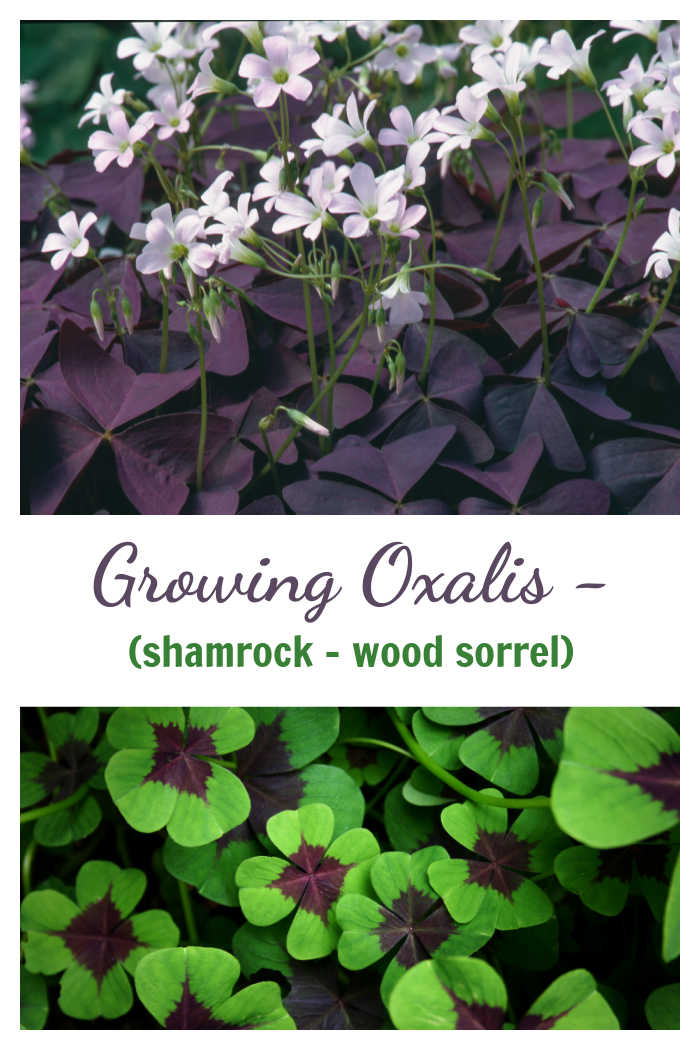
What is oxalis?
Oxalis is a large family of flowering plants in the sorrel family with close to 800 species. It is found in most areas of the world and is very common in Mexico, South Africa and Brazil.
The plant is sometimes referred to as a false shamrock because of the shape of its leaves but is not a member of the shamrock family.
The plant is as happy outdoors in your garden as it is, inside, growing in a pot.
While many varieties of oxalis are invasive, ornamental oxalis is not to be shunned. It can take pride of place in any garden bed.
[bctt tweet=”St. Patrick’s Day will soon be here. Why not grow a shamrock plant? Oxalis has shamrock shaped leaves and gorgeous flowers. Grow in indoors now and plant it outside in early spring. Get the growing tips on The Gardening Cook. #oxalis #shamrockplants ☘☘☘” username=”agardeningcook”]
As an Amazon Associate I earn from qualifying purchases. Some of the links below are affiliate links. I earn a small commission, at no extra cost to you, if you purchase through one of those links.
Characteristics of oxalis
Type of Plant
Oxalis is grown from small bulbs. It is relatively a slow growing perennial which spreads easily in a garden bed.
Oxalis flowers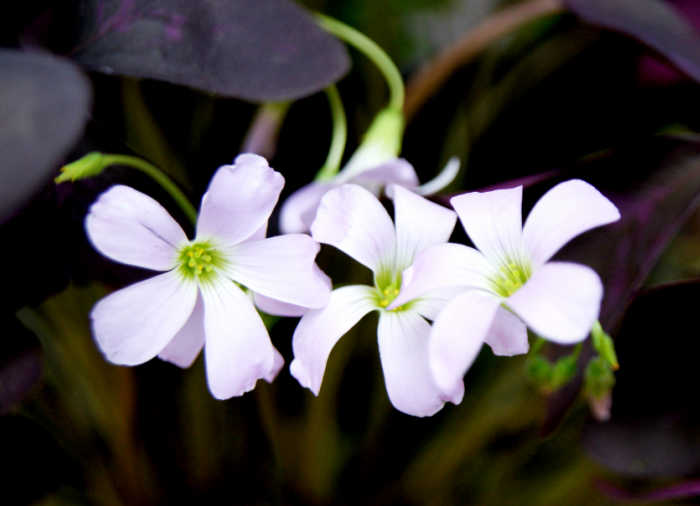
Depending on the color of leaves, the flowers can be white, yellow, rose colored or pink. The flowers grow on top of bare stems and are quite dainty, and thin, like the leaves.
The plant tends to bloom in late spring or early summer.
Leaves of oxalis plants
The foliage of this plant really pops at the garden centers in early spring. The deep maroon (almost black) leaves of oxalis triangularis stands out near other dark green foliage plants.
The leaves of the plant can be green or purple and have a three leaf clover look which gives it the common name “false shamrock”. In Ireland, four species of oxalis are associated with good luck.
Some leaves have a speckled appearance to them.
There are varieties with solidly colored leaves and also those that are variegated.

Oxalis plants are nycytinastic
One interesting aspect of oxalis plants is how their leaves react at night.
The leaves of the purple shamrock – oxalis triangularis – have a habit of closing up at night, a trait known as nyctinasty. This habit is caused by light and temperature variations at night.
Although oxalis can take some sunlight, it is not uncommon for the leaves to wither and drop off in the middle of summer. Plants in a slightly shady spot seem to do better.
It grows better in the spring months when the temperatures are cooler.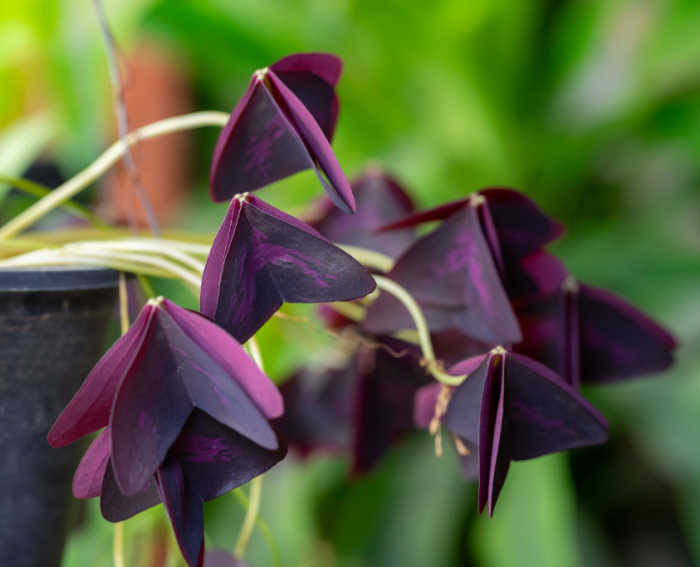
Toxicity of oxalis
The leaves are poisonous to pets but they have a bitter taste to them so poisoning is not too much of a problem since cats and dogs tend to avoid the plant.
Size and growth habit of shamrock plants
Oxalis is a mounding plant and grows to about 12 inches tall and wide. Some varieties spread quickly and others are fairly slow growing.
Some types of the green oxalis can be quite invasive, but the ornamental purple oxalis is easily contained.
Invasive oxalis
Oxalis pes-caprae, also known as “buttercup oxalis,” is an invasive variety from South Africa that was transplanted to California in the 1900s.
Oxalis plant care in your garden
Soil Requirements for oxalis
Well draining soil that is slightly acidic soil is ideal. (Coffee grounds sprinkled nearby can help with the acidity of the soil.)
Using lots of organic matter or compost before you plant the bulbs will be beneficial.
Sunlight needs for shamrock plants
The plant will grow best if it gets a few hours of sunlight every day. Afternoon shade is ideal. I have some growing in a sunny spot and others in my shade garden, and those in the shady spot seems to flourish the best.
The leaves of oxalis may wilt slightly in the afternoon sun but recover quickly as the cooler temps come later in the day.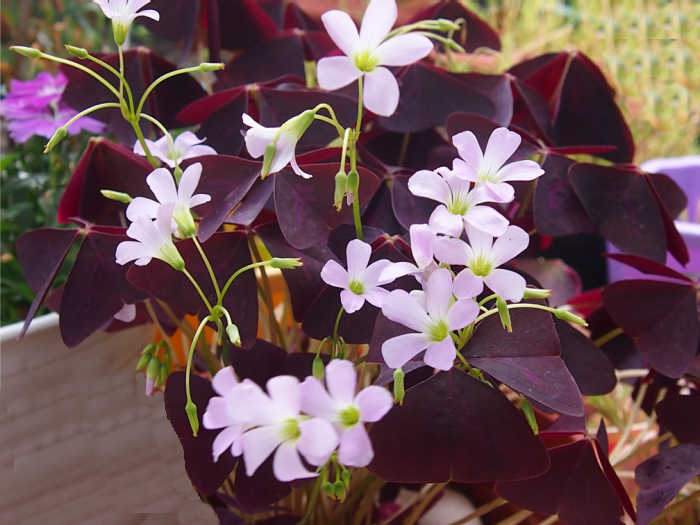
Plants with the darker purple leaves do better with less sunlight than those with the green leaves.
Watering and fertilizer needs of oxalis
Oxalis likes a moist soil that drains well but does not like to be in a soggy spot. Bulbs will rot easily if the soil is too wet, so be careful of over watering.
On the other hand, don’t underwater, especially in the middle of summer.
Fertilize regularly during the growing season with a normal plant food at half strength.
How to propagate oxalis
Get more plants for free by digging up and dividing the clumps of bulbs below the soil. Most oxalis plants remain fairly compact and are unlikely to need division very often in the garden.
The plants also self seed so once you have a few plants growing, they will spread. (This can be a problem if the garden beds do not have edging and grow the more invasive types which will spread to your lawn.)
Cold hardiness for oxalis
Some varieties of he plant are cold hardy in zones 6 and warmer. It depends on the variety though. Many varieties are frost tender and will not over winter, so they are treated as annuals.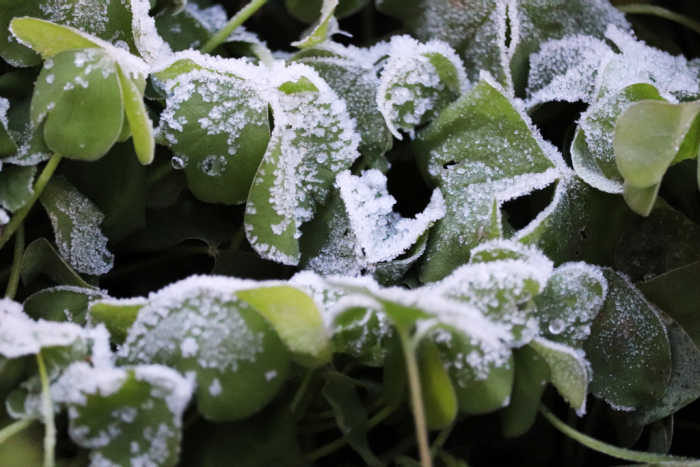
Check your plant label for hardiness details.
To overwinter oxalis, dig the bulbs up and grow them as indoor plants for the winter months and then replant again in the spring.
Growing oxalis indoors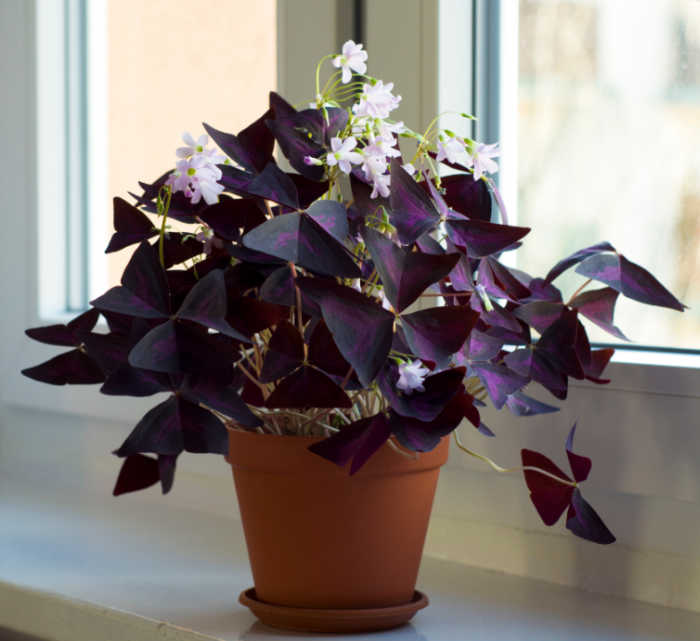
Oxalis plant care indoors is as easy. Just be careful of water frequency and give it bright sunlight.
This perennial loves a shady outdoor spot but can also be grown as a houseplant. Growing oxalis indoors means placing it in bright light in a room with cool temperatures if you can. (60-70 degrees is ideal.)
The more light the plant has, the darker the foliage will be, but too much sunlight can cause the leaves to “bleach out.” Feed with a regular houseplant fertilizer during the growing months.
Uses for oxalis
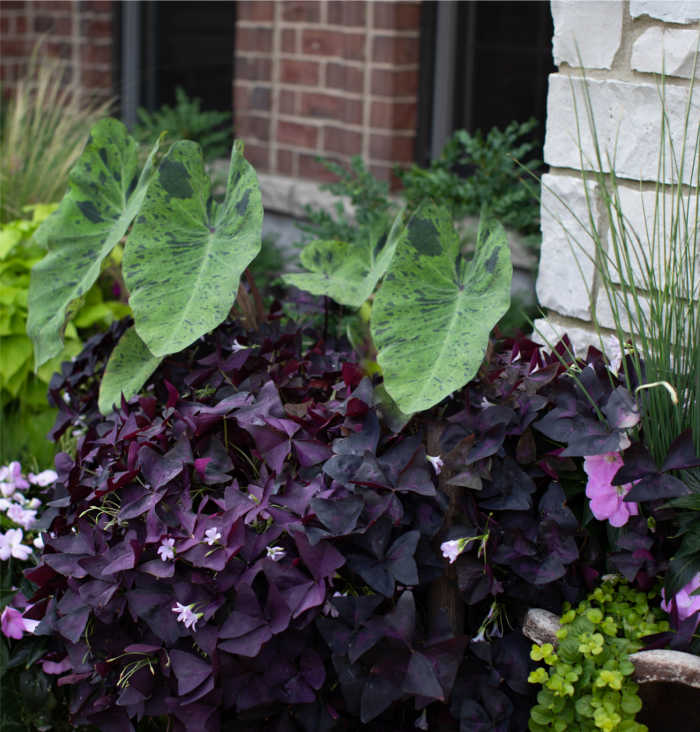
Shamrock plants look lovely along the border of a walkway.
Outside, oxalis has long lasting flowers and pretty foliage in a semi shady garden spot. The foliage of purple oxalis triangularis adds a nice break from normal green garden foliage.
Indoors, Plant it in pots and display during the St. Patrick Day holidays. It also looks gives a lovely contrast in terrariums.
Where to buy ornamental oxalis
Check your local big box hardware store. They sometimes have ornamental oxalis for sale.
Another good place to find oxalis for sale is your local Farmer’s Market, especially as spring approaches. There are many places to purchase oxalis online.
- Buy oxalis bulbs on Amazon
- Find oxalis triangularis on Etsy
- Purchase iron cross oxalis at Harmony in the Garden
Controlling invasive oxalis
There are close to 800 types of oxalis, but most are not considered invasive weeds. The two most common invasive types are creeping wood sorrel and Bermuda buttercup.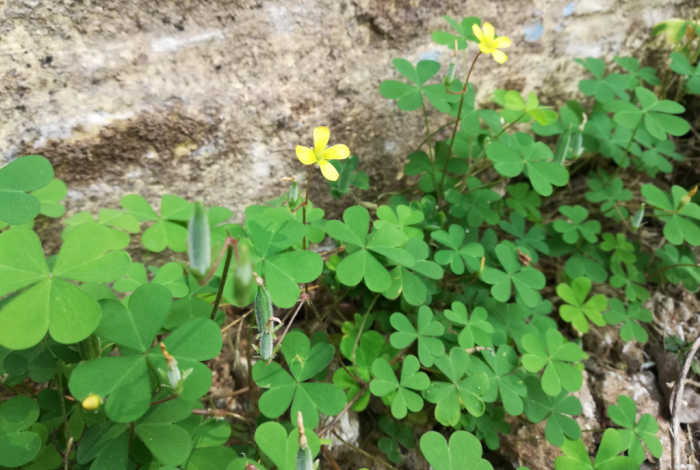
Since the plant spreads under ground, be sure that the garden beds where you grow them have some sort of deep edging or trench edging to keep them contained.
Management of weeds in a lawn is difficult. Laborious hand digging does the job, but this can take several seasons to get it all. Don’t try to pull oxalis out by hand.
Even a small piece of the root will re-grow and form new plants.
A broad leaf plant herbicide is best to try and control it, or for a more organic method, try liquid chelated iron, which also works on other clover type weeds in a lawn.
Growing oxalis outdoors in a shade garden or indoors as a house plant is very easy. If you plan to have guests over for St. Patrick’s day and looking for a way to decorate, be sure to include a pot or two of ornamental oxalis.
The shamrock shaped leaves are the perfect St. Patrick’s Day decoration.
Pin these oxalis plant care tips for later
Would you like a reminder of these tips for growing ornamental oxalis? Just pin this photo to one of your gardening boards on Pinterest so that you can easily find it later.
Admin note: This post first appeared on the blog in January of 2018. I have updated the post to add more growing tips, all new photos, a printable project card and a video for you to enjoy.
How to Grow Oxalis
Oxalis is often grown outdoors in semi sunny locations, but you can also grow it as a houseplant. These care tips will help
Materials
- Oxalis bulbs
- Compost or other organic matter
- Well draining soil
- All purpose plant food
Tools
- Watering can
Instructions
- Choose a semi sunny location.
- Till the soil and add organic matter to enrich it. Be sure the soil is well draining.
- Plant oxalis bulbs 3-4 inches apart.
- Water well.
- Fertilize once a month during the growing season with half strength all purpose plant food.
- Propagate by dividing the clumps of bulbs.
- Flowers appear in late spring to early summer.
- Most varieties are cold hardy in zones 6 and above. In colder climates, dig up the bulbs to use as indoor plants.
- The purple varieties of oxalis are not invasive. Be careful of some of the plain green ones which can take over a garden or lawn quickly.
55 responses to “Oxalis Plant Care – How to Grow Shamrock Plants – Growing Ornamental Oxalis”
Wow! This article really helps! Now, I am confident to grow it indoor. Thanks
Hi Aries. I”m glad you found the article useful.
Please tell me how deep the bulbs should be planted in an indoor potted plant: also, number of days to see plants emerge.
The bulb package has this information on the back of it. IT can vary depending on the type. Normally bulbs are planted about 6-8 inches deep. Plant growth depends on the time of year and temperature.
I have several kinds of this in my garden and it is growing like crazy and spreading almost everywhere. Wasn’t sure what to do with it so I appreciate the information and enjoyed your article. Thank you
I’m glad you found it useful Michael. Oxalis can be somewhat invasive, but it’s easy to control since the roots are shallow.
I received free bulbs with a seed order. These got thrown out with vegetable scraps which I buried into a sawdust pile. I have a healthy Oxalis plant on top of the sawdust pile this spring. Wow!
I had that happen with some pumpkin seeds in a compost pile. It was the biggest butternut pumpkin I ever grew!
Is that shrimp like thing oxalis grows from really called a bulb ? I was frightened by it the first time I saw it, thinking it was a large insect !
Yes.no need to worry. That is how they grow.
How do you store the bulb over winter if you aren’t using it as a indoor plant?
Remove all the dead foliage. Bring them indoors and place in a single layer. The root clumps can be stored in a net bag like oranges come in or a paper bag to keep all the pieces together.
I have purple shamrock oxalis and it has developed yellow spots on the underside of the leaves is this a disease or is it in the wrong place.
Oxalis leaves can turn yellow for many reasons (overwatering, old age, and fungal diseases.) They also have a dormant season and some leaves may yellow prior to this.
Discard the yellowing leaves and watch the plant to see if it recurs.
Could you tell me what affects the size of the leaves? I gave some corms to a friend and hers appear much bigger than mine.
Thx
The type of soil, or fertilizer can play a part. Light situations also affect size. How much the plant is watered also matters.
Mine have been growing great inside but all of a sudden they started leaning, but before that they were straight up. Do you know what causes this? Do they just get too heavy? Thank you
Too little water can cause a shamrock plant to wilt. Too low light can also do the same thing.
However, sometimes Oxalis often just decides to go dormant. (they do this outside in the fall.) The plant sort of gives up until you give it a dry rest & start over. When the plant starts getting droopy – let it go completely dry, then cut it back to the soil line. (you can divide or repot at this time. Give it a rest then start watering again.It should come back.
Ok perfect. How long should I let it rest? Thank you!
Hi Samantha, The best way to treat a dormant plant is to let it dry out and keep it over the winter in a cool dry place. It’s hard to know by email if this is what your situation is. Outdoors, the plants go dormant over the winter.
It grows from tubers and I have done this with caladiums with good success. I just neglect them for a few months in winter and then repot in spring.
Can I cut my indoor Oxalis plant back to the soil not injuring the little bulb. I had an Oxalis for years that I would just cut back all the green every four or five months or so and it would come right back….alll year…no dormant period.
Yes this is fine. Dormancy depends on hardiness zone.
Mine (indoor pot) goes dormant usually during the winter months, although not for very long; I usually have growth most of the year. I re-potted this spring and it got larger than ever and loved the new ‘space’ it had; I recently moved it to a different area (bc my cat was eating the leaves and then throwing them up); a little while after I moved it, it began to droop and then I actually overwatered it by mistake – I dried it out as best I could, but it did develop some white mold; I have wiped that away and am hoping it will bounce back. I am wondering if I should repot it or wait a bit as I don’t want to shock it anymore than it may already be. Any advice would be appreciated, I have had this plant for several years and would hate to loose it.
Repotting is only done when a plant is pot bound.
Does it grow like one clover per bulb? Can I get bushy growth from one bulb or should I cluster them for fullness?
Each bulb will grow into one plant. Eventually they will naturalize and develop more bulbs but initially, you can cluster them for more fullness.
Can the tubers be cut in half to propagate more plants? I just repotted mine and the tubers are about 4 inches long.
I have never tried doing this for large oxalis tubers. Most directions for propagation suggest division of the tubers, not cutting them to produce two plants. I have had elephant ears grow from just a part of a tuber, so if you have an extra one, it would be good to try it and see. (let us know if it works!)
The outer edges of my oxalis plant are turning brown. Could you tell me what I am doing wrong. I have always had them in doors and still do. I love them and I don’t want to lose them. Thank you.
My shamrock plant has wilted curled leaves. what is wrong and how do I fix the problem
A wilted plant can be the result of either ower-watering or under-watering the plant. IF the leaves are mushy and curled, it has too much water. If they are dry and curled, you can water a bit more.
I tried to transplant one fro. A pot inside to outside recently and they all died. What did I do wrong? Separated bulbs planted just below the surface semi-shady spot in early spring.
Sometimes moving from indoors to outdoors gives the plant a shock since the conditions are quite different. Plants placed outdoors that have been grown inside can’t take the extremes in temperatures without being hardened off before leaving outside. Oxalis is a perennial though, so it COULD come back next year with some luck.
My Shamrock came from a start of a friend It has done so well decided to plant it in a larger pot at first it filled the spot and was beautiful then the leaves turned color then swiveled came back once mow I have the same situation as before. What am i doing wrong.
Oxalis will often die back in the fall and then come back in spring. Repotting can be tricky if you use a pot that is too much larger. 1/3 extra in size is the suggestion if the plant is very pot bound.
Very informative article. My daughter gave me a kit to grow the purple shamrock plant but the directions are unclear so I’m hoping you might help. The bulbs are small, oblong, dried, and several have a little bit of what looks like white string on one end. Will that end become the root or will that become the stem? I guess what I need to know is the direction in which to plant them – white string down or up or does it matter? Thanks!!
yes, it sounds like those are the roots. Bulbs and rhizomes will usually find their way in the soil, but if you make sure to plant the roots (strings) downward it will help greatly.
Hi theres some yellow notes under the leafs, is that a problem? So how can i fix it?
I’m not sure what you mean by yellow notes.
My OXALIS REGNELLII has started developing whit edges on the green leaves. Looks more like a burn than a fungus. It’s a houseplant so doesn’t get a lot of sun. Maybe still too much or our water?
I’m afraid I can’t diagnose problems with individual plants.
I have limited space ,just wanted to know if I could replant the purple oxalis with the green oxalis and still keep their color? Thank you Doreen
They can be planted near each other. It won’t affect the color that I know of.
I received some of the purple oxalis from my mom. (August 2020) Two rhizomes. They were already growing. I brought them home in a cup of water! I planted them in a pot and they seemed happy in their new home. Then cat happened. Dumped the plants, shredded the leaves/flowers. I panicked, but mom said go ahead and replant. I did and about a week-two later I had new plants! They’re seeming to thrive and are even flowering!
I picked up a few of the purple oxalis at a local farmer’s market this spring because they were so different. I have a shady spot & never had much luck with impatients & wanted some color in this spot directly in front of my house. They did extremely well!! (I don’t necessarily have a green thumb!) My question is this: I live in central PA and I’m concerned if they will survive the winter. I don’t have much area in my house to keep plants indoors plus I have 2 cats. Suggestions? Thank you!
Oxalis is hardy to zone 6 and warmer. Pennsylvania has hardiness zones of 5a, 5b, 6a, 6b, 7a and a very small section of 7b. So depending on which zone you are in they may overwinter.
I have grown these plants for decades as house plants and sometimes move the pot and all to the garden for the summer, just put the pot in the ground nearly to the rim. As I live in northern Minnesota I can put them out almost anywhere. One of the folk tales about them is that the triangle leaved ones do not play nice with the round leaved ones and you cannot keep them in the same room. I found this to be so and in my house I had to keep the round leaved one on the upper floor to keep it growing and blooming. What is this and why does it happen.
Hi Traci. Thanks for the info. I’ve never heard of this habit. Perhaps one of the readers can weigh in on why they might not grow well together.
Hi, I was given an Oxalis for St. Paddy’s day and its been growing in a pot for 10 months
now it looks anemic with these fuzzy stems etc. what am I doing wrong? It gets sunlight in the afternoon and I water it when the soil gets dry.
Judy Rosales
I live in the Mojave desert in Calif.
It’s normal for the stems to be fuzzy. Oxalis often has a dormant period indoors during the colder months.
I live in north eastern MN and walked from the store-car-car-house, and the plant immediately wilted. I decided to leave it alone and let it settle inside. I’m wondering what I can do to keep this plant Alive and thriving. I plan to replant it (indoors). What should I do/expect in this situation.
Hi Anndrea. I don’t diagnose any plant problems without seeing the plant in person. A local garden shop or the store you bought it from should be able to help you.
I have propogated an oxalis plant for years, and given many as gifts. Recently, I took an overgrown one and divided it into two. The larger one is doing fine. The smaller one, in a smaller pot, seems fine, but has yet to shoot up any flowers. Can you give a reason for this?
Division can sometimes harm the tubers and set the plant back a bit. They should grow in time.
All the things I wanted to know Thank you’Such a pretty little plant